
Stop Vibe Coding Before It Ruins You
4 min read0 views
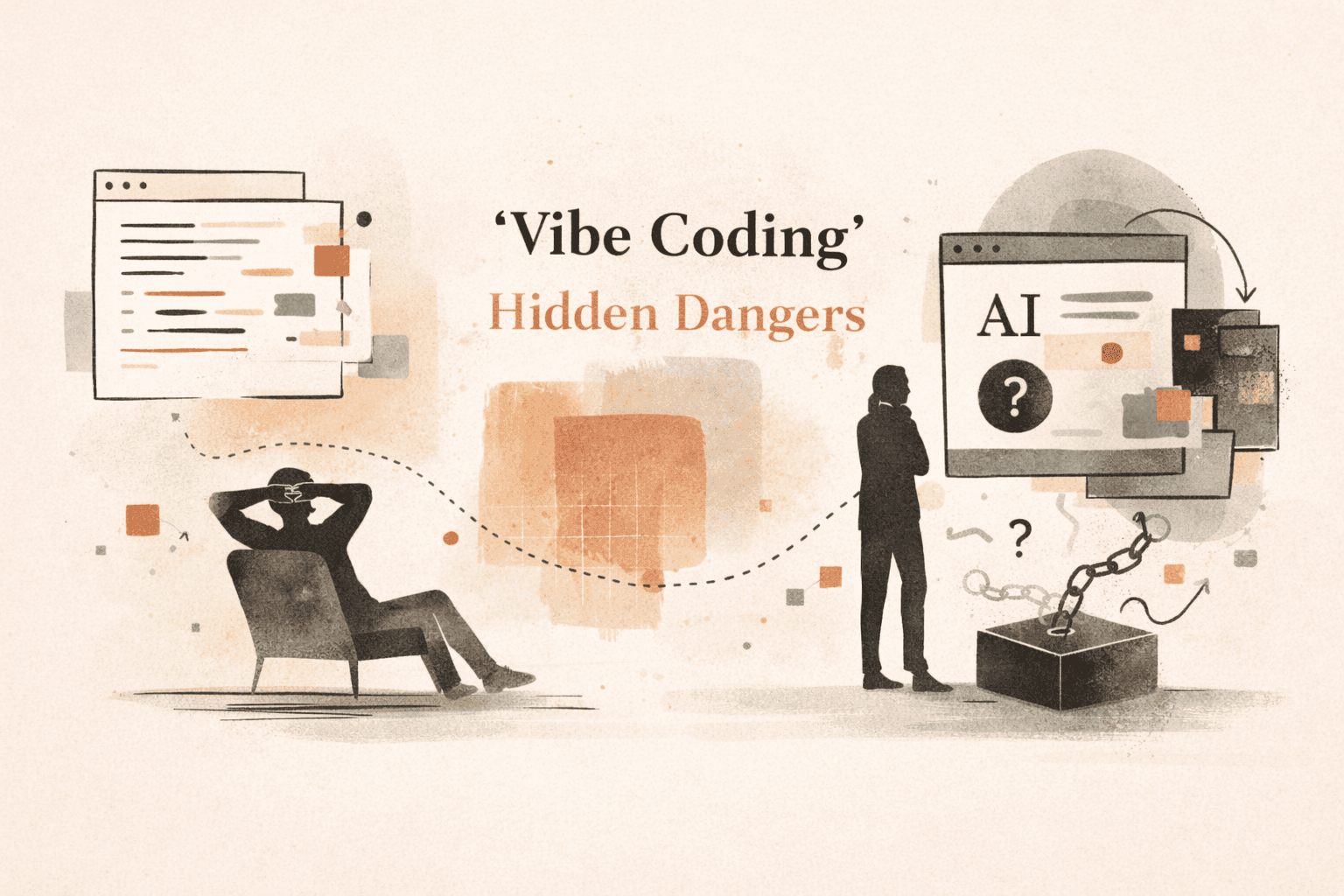
You know the feeling. You type a prompt. The AI produces 300 lines of perfectly structured React components. You hit Tab. For a brief, intoxicating moment, you feel like you just compressed four hours of work into four seconds.
This is Vibe Coding — the idea that you can build software by vibes alone, guiding the AI through natural language and never worrying about the implementation details underneath.
It is the trend of the year. And I'm here to tell you that if you're not careful, it will make you the most replaceable developer in any room you walk into.
There is a new archetype emerging in our industry. I've started calling them "Senior Juniors."
These are developers who can deploy a complex SaaS application in a weekend — senior-level output — but cannot explain how a useEffect dependency array actually works. They are building skyscrapers on quicksand.
When you Vibe Code without understanding, you are borrowing technical debt from the future. The code works until the edge case hits. The app ships until the database locks up under load. The UI looks polished until you need to refactor a component that the AI hallucinated into a spaghetti mess.
If you're just accepting every suggestion without auditing it, you're not a developer. You're a spectator. And spectators don't get paid to solve the hard problems.
I work with React and build things every day. AI is part of my workflow. It's genuinely a superpower. But here is the critical difference:
I only use AI to write code I could have written myself.
If Copilot suggests a complex query and I don't understand exactly what it's doing to memory or execution time, I delete it. Immediately. No exceptions.
The danger of Vibe Coding is that it hides the why. It hides why we use specific design patterns. It hides why certain rendering cycles cause lag. It hides the fundamentals that took our industry decades to learn the hard way.
If you skip the struggle of learning those fundamentals, you have no intuition. And when the AI gets stuck — and it will — you'll be stranded in the middle of the ocean without a paddle.
Now you might think I'm saying we should go back to coding in Notepad and memorising documentation.
Absolutely not.
If you stop using AI tools in 2026, you are choosing to be slow. In the game of shipping products, speed is survival. I wouldn't be able to handle the volume of work I do without these tools.
The goal isn't to stop Vibe Coding. The goal is to stop using it as a crutch and start using it as a jetpack.
Here is how you survive the AI wave without your skills rotting away.
The "Explain It Like I'm 5" rule. Before you commit any AI-generated code, ask yourself: could I explain this line-by-line to a junior developer? If the answer is no, you are not allowed to commit it. Ask the AI to explain it. Learn the syntax. Then commit.
Vibe for boilerplate, sweat for logic. Let the AI write your Tailwind classes and your API fetch wrappers. Let it handle the boring, repetitive scaffolding. But when it comes to your core business logic, your authentication flows, your data integrity — you need to be hands-on. Do not outsource your brain.
Learn the hard parts intentionally. Spend your free time learning the things AI is bad at: system architecture, database design, performance optimisation. These are the skills that compound over a career. These are what separate a developer from a prompt typist.
Vibe Coding is here to stay. That's not the question.
The question is who wins the next decade. It won't be the "Prompt Engineers" who can generate the most code the fastest. It will be the technical architects who have the deep fundamentals to know which code to generate — and more importantly, which code not to.
Don't let the vibes make you lazy. Let them make you efficient.
There is a difference.
Vibe Coding with AI can boost productivity but risks making developers reliant on tools without understanding the underlying code, so it's crucial to use AI for boilerplate while mastering fundamentals and core logic to remain valuable and effective.